



How does the proportion of elastic fibers added to silk women's pajamas affect comfort?
Release Time : 2025-12-30
The proportion of elastic fibers added to silk women's pajamas is one of the core factors affecting their overall comfort. This subtle adjustment not only affects the fabric's softness to the touch but also directly impacts the fit, freedom of movement, and long-term durability, ultimately creating the unique wearing experience of silk women's pajamas.
Silk fabric itself is primarily made from mulberry silk, whose natural fiber structure gives it softness, smoothness, and breathability. However, pure silk has relatively low elasticity and is prone to wrinkling and even localized deformation due to stretching or frequent movement. This characteristic is particularly noticeable in the context of silk women's pajamas—movements such as turning over or sitting up during sleep require the fabric to have a certain degree of stretch to adapt to changes in body posture. If relying entirely on pure silk, silk women's pajamas may become loose and deformed at the neckline or cuffs after repeated wear, affecting both aesthetics and comfort. Therefore, the introduction of elastic fibers is crucial for optimizing the performance of silk women's pajamas.
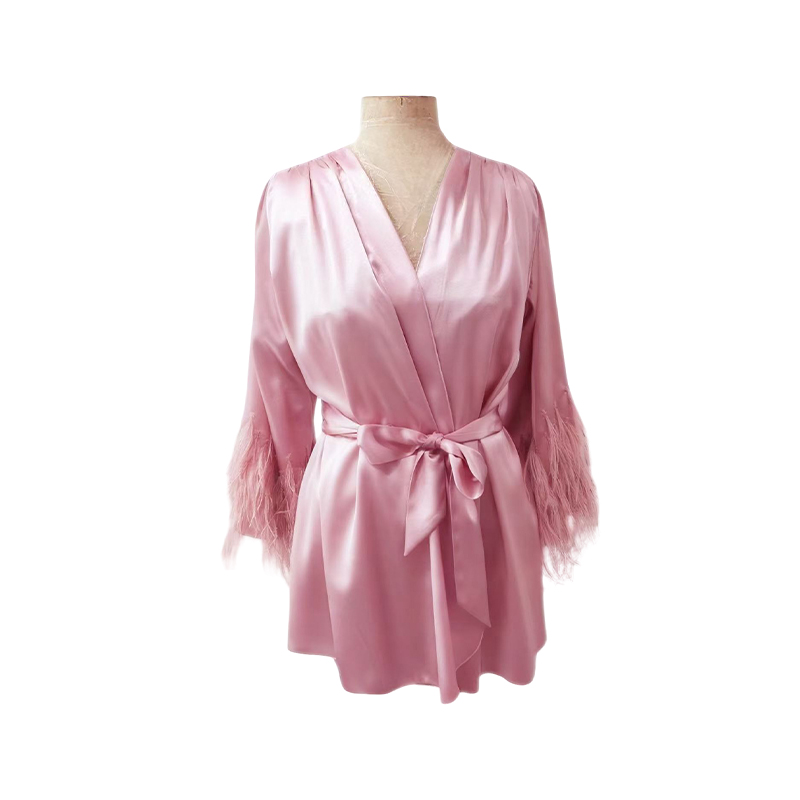
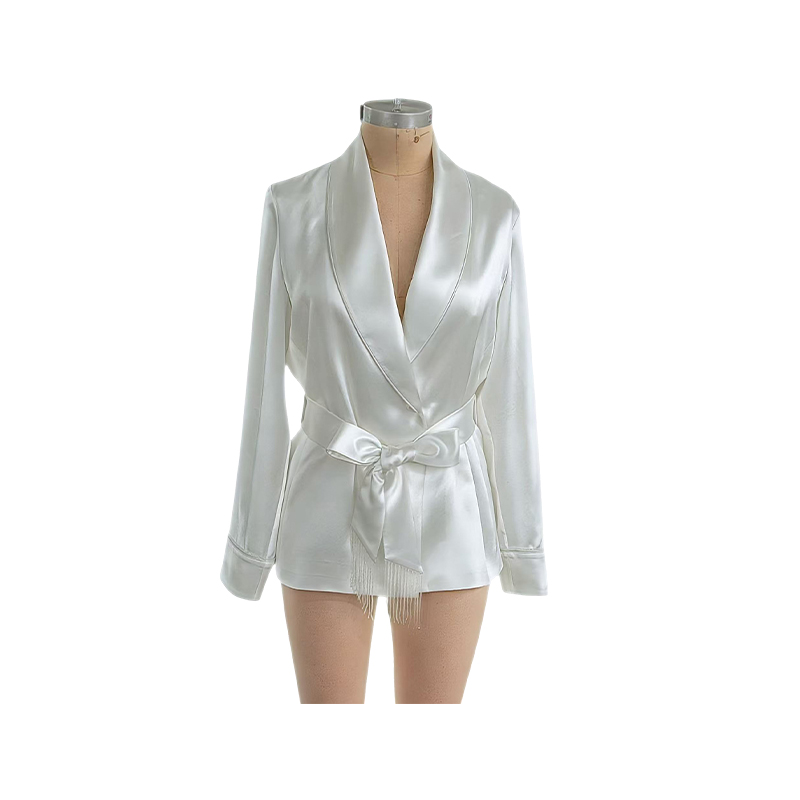
The proportion of elastic fibers added primarily affects the fit of silk women's pajamas. An appropriate amount of elastic fibers (such as spandex) provides the fabric with slight elastic tension, allowing the pajamas to naturally conform to the body's curves when static, avoiding a sloppy feel caused by loose fabric. When in motion, they can stretch appropriately with body movements, reducing any sense of restriction. For example, when the proportion of elastic fibers in silk women's pajamas is controlled within a reasonable range, whether it's the shoulder straps of a camisole style, the waistband of a suit style, or the cuffs of a bathrobe style, it can provide a "fitting yet comfortable" wearing experience while maintaining the smooth touch of silk, feeling as natural as a second skin.
Freedom of movement is another important dimension. The body is not completely still during sleep, especially in positions such as side lying or curled up, requiring the fabric to have sufficient elasticity to avoid tightness or tearing due to stretching. The addition of elastic fibers creates "elastic memory," allowing the fabric to quickly return to its original shape after being stretched, reducing fatigue damage caused by repeated stretching. This characteristic is particularly crucial at the joints of silk women's pajamas (such as elbows and knees)—insufficient elastic fiber ratio can lead to whitening, pilling, and even breakage in these areas due to frequent bending; a proper ratio, however, ensures the fabric maintains its luster and integrity for a long time.
Long-term durability is also closely related to the elastic fiber ratio. While pure silk fabric is soft, it is relatively abrasion-resistant, especially after frequent washing or friction, making it prone to fiber breakage and pilling. The addition of elastic fibers enhances the fabric's structural stability and improves its abrasion resistance. For example, when elastic fibers intertwine with silk to form a tight fabric structure, the friction between fibers increases, reducing the risk of individual fibers detaching; simultaneously, the elastic recovery of elastic fibers can offset some of the mechanical force during washing, extending the lifespan of silk women's pajamas.
Furthermore, the elastic fiber ratio indirectly affects the breathability and moisture absorption of silk women's pajamas. While elastane itself has relatively low breathability, when blended with silk in a proper ratio, it doesn't significantly disrupt the porous structure of the silk fibers, maintaining the fabric's excellent ventilation and moisture-wicking properties. This balance allows silk women's pajamas to provide moderate elasticity without feeling stuffy due to the fabric's density, making them especially suitable for summer or for those prone to sweating.
From a wearing scenario perspective, different styles of silk women's pajamas require different proportions of elastane. Camisole styles, due to their larger contact area with the skin, need to prioritize the fabric's softness and fit, allowing for a slightly lower elastane ratio. Suits, involving more active areas (such as the waist and cuffs), require a higher proportion of elastane to ensure freedom of movement. Bathrobes, on the other hand, need to strike a balance between looseness and drape, requiring precise control of the elastane ratio to avoid the fabric becoming too baggy.
The proportion of elastane added to silk women's pajamas is a core parameter that optimizes fabric structure, enhances functionality and durability, and ultimately impacts wearing comfort. It not only solves the problem of insufficient elasticity in pure silk fabric, but also achieves a balance in multiple dimensions such as softness, fit, breathability, and durability through scientific formulation, making it an invisible assistant to improve sleep quality.